



One of the most common fears during renovation is simple: "Will I pay money in advance and then the craftsman disappears?" This concern is completely understandable. Renovation is usually a large expense, the work happens in stages, and the client cannot always be on site every day to check how far everything has progressed.
That is why at Happy Builder we do not work with unclear verbal arrangements such as "give us some money now and we will sort it out later". Payments are described in advance in the contract and are linked to actually completed and accepted work. This way both the client and we know when each payment is due, why it is due, and how progress is proven.
Why there is an advance payment
When starting a renovation, there is usually an advance payment. In our standard contract it is 30% of the contract value. This payment is needed because even before the actual work starts there is organization: team planning, reserving the schedule, preparing tasks, deliveries, logistics, and initial project costs.
The important point is that the advance is not "money on trust" without further structure. After it, the renovation moves in stages, and every following payment is linked to a reached percentage of completed work.
How stage payments work
After the advance, the remaining payments are made according to a predefined schedule. For example, the next payment becomes due when a certain total volume of work on the project has been completed.
| Payment name | Total completed work volume when the amount is due | Payment amount |
|---|---|---|
| Stage 1 payment | 30% | 20% |
| Stage 2 payment | 50% | 15% |
| Stage 3 payment | 70% | 15% |
| Stage 4 payment | 90% | 15% |
| Stage 5 payment | 100% | 5% |
The exact percentages and conditions are part of the contract for the specific site. The principle, however, is always the same: payments do not happen randomly; they follow the real progress of the renovation.
Example with a contract for 10,000 €
| Moment | Payment | Amount | Total paid so far |
|---|---|---|---|
| After signing the contract | Advance payment 30% | 3,000 € | 3,000 € |
| At 30% completed work | Stage 1 payment - 20% | 2,000 € | 5,000 € |
| At 50% completed work | Stage 2 payment - 15% | 1,500 € | 6,500 € |
| At 70% completed work | Stage 3 payment - 15% | 1,500 € | 8,000 € |
| At 90% completed work | Stage 4 payment - 15% | 1,500 € | 9,500 € |
| At 100% completed work | Stage 5 payment - 5% | 500 € | 10,000 € |
How we prove the percentage of completed work
The percentage of completed work is not determined by eye. For this purpose, we use a document that we call a handover protocol. It includes the tasks that have been reported as completed and accepted.
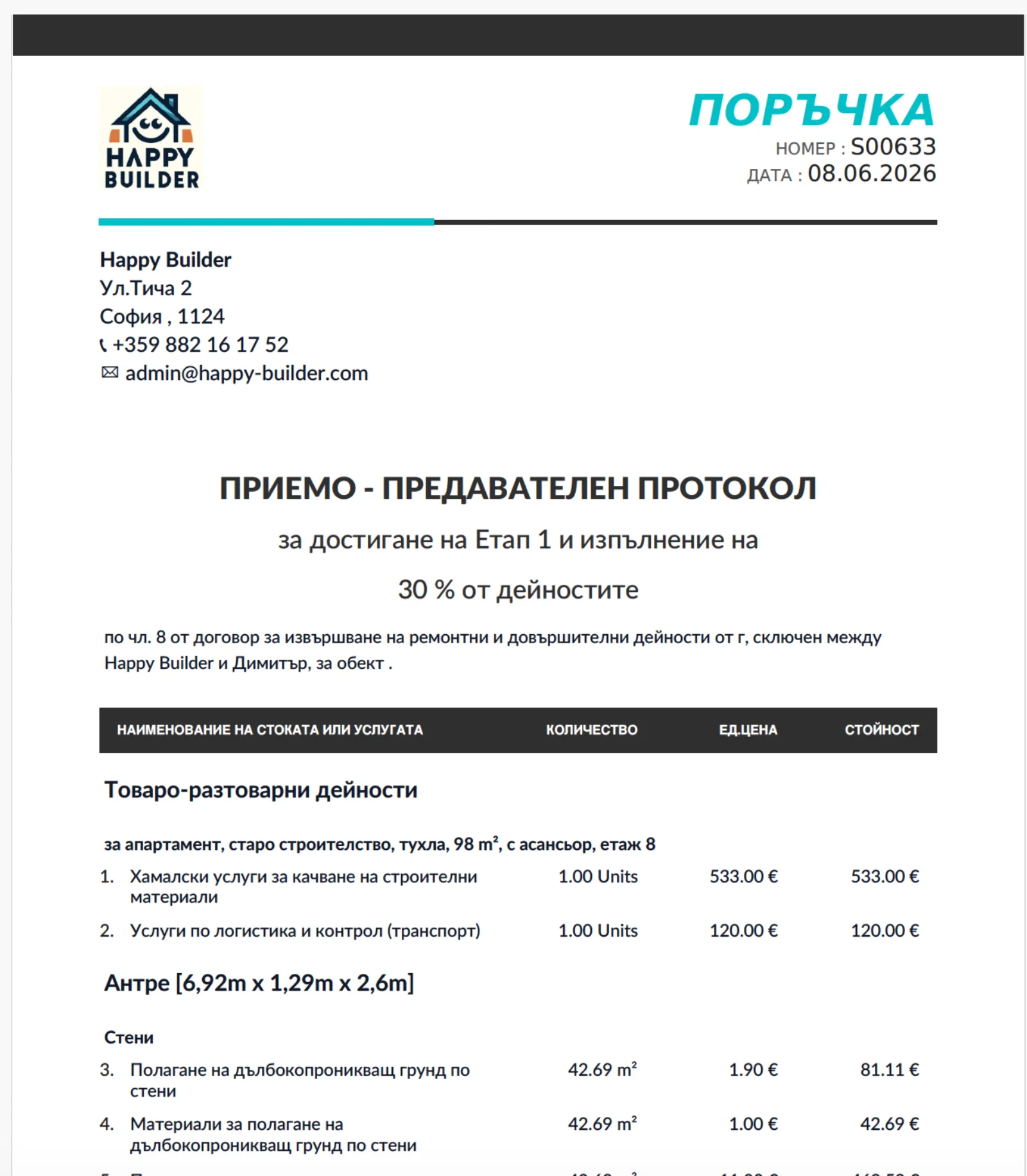
This is an important difference. The client does not simply receive a message saying "we are 50% done". The percentage is based on specific items from the offer and their acceptance. This links the payment to described activities, not to a general impression.
How a task becomes completed
At Happy Builder we work with project tasks. When the contractor finishes a specific task, it does not disappear into a chat or a verbal arrangement. It is marked as completed, checked, and after approval it becomes part of the reported progress.
This process is described in more detail in the article about the Happy Builder mobile app, where we show how the client can track tasks, statuses, photos, and project development. When the status of a task changes, the client gets visibility instead of waiting for unclear information over the phone.
We use similar logic when planning renovation work. In the article how we plan renovation through tasks, craftsmen, and timelines, we explain why renovation should be broken down into specific activities instead of being managed as a general promise that "it will be done in a few weeks".
What the client sees
The goal of this system is transparency. The client should know the agreed scope of the renovation, the payment stages, what percentage of work has been completed, which tasks have been reported as done, when the next payment is due, and what remains until final completion.
This way, the renovation is not a black box. The client does not have to guess whether the work is progressing or why another payment is being requested. Every next installment is linked to a stage of execution.
Why this model protects both sides
For the client, this model reduces the risk of paying a large amount without clarity about what has been received in return. For us as the contractor, it is also important because renovation requires constant resources: craftsmen, organization, materials, deliveries, and control.
The healthiest model is balance. The client does not pay everything in advance. The contractor does not finance the entire renovation until the end without interim payments. Instead, payments and execution move together, according to predefined conditions.
The final payment is after completion
The final part of the payment remains for the end. It becomes due when the work is 100% completed according to the agreed scope. This is the normal final stage: the site is completed, the performed activities are accepted, and the final payment is made.
This makes the financial side of the renovation clear from the beginning. There are no surprise requests, no unclear interim sums, and no dependence only on verbal promises. There is a contract, stages, tasks, acceptance, and traceable progress.
Do you want a renovation with clear payments and traceable progress?
Send us information about the property and we will prepare an offer with a specific scope, stages, and execution terms.
Request an offerFrequently asked questions
Is the entire renovation paid in advance?
No. There is usually an advance payment, and the following payments are linked to a reached percentage of completed and accepted work.
How is the amount of completed work proven?
The completed volume is described in a handover protocol based on specific tasks and items from the offer.
When is the final payment made?
The final payment is made after the work is completed according to the agreed scope and the final stage is accepted.